EN
EN

PUF Panel vs PU Panel for Container Houses: Which Insulation Is Better?
When evaluating sandwich panel specifications for a container house procurement order, one of the first questions that comes up is whether to specify PUF panels or PU panels. If you've sourced prefab structures from Asian manufacturers before, you've likely seen both terms used (sometimes interchangeably, sometimes as if they're entirely different products). From a procurement standpoint, understanding what each designation actually means matters more than it might seem at the quotation stage.
Most project budgets default to focusing on unit price per square meter. That's a reasonable starting point, but the panel specification determines how a container building performs over a 10–20 year deployment cycle . The panel spec determines whether it maintains thermal stability in a European winter, holds up under repeated heavy rainfall on a coastal Australian site, or stays structurally sound in a mining camp with high daily foot traffic. If your project has a longer operational horizon, getting this selection right at the sourcing stage is worth more than the price difference between specifications.
PUF Panel vs PU Panel: What the Terminology Actually Means
PUF stands for Polyurethane Foam; PU refers to Polyurethane. In practice, these names describe the same foam chemistry — polyol and isocyanate combined to form a closed-cell rigid foam core. The distinction is largely regional: PUF is the more common designation used by South Asian and East Asian manufacturers, particularly when describing high-density foam cores intended for puf panel roof and wall applications. PU is the broader international term you'll see in European and North American specification sheets.
When a Chinese or Indian manufacturer quotes a "PUF panel roof system," they are referring to a polyurethane foam-core sandwich panel — the same base material category as a PU sandwich panel in an international spec. The actual performance difference, if any, comes down to the density and formulation of the foam core, not the abbreviation. A higher-density PUF core (≥40 kg/m³) will generally outperform a standard-density PU core (30–35 kg/m³) on compressive strength and dimensional stability, which starts to matter more over a long deployment cycle.
5-Dimension Performance Comparison
For engineering and procurement teams evaluating container house panel specifications, these five dimensions drive the majority of material selection decisions in practice.
| Performance Dimension | PUF Panel (High-Density, ≥40 kg/m³) | PU Panel (Standard, 30–35 kg/m³) |
|---|---|---|
| Thermal Conductivity (λ) | 0.022–0.026 W/m·K | 0.025–0.028 W/m·K |
| Fire Rating | B1 (DIN 4102) / B-s2,d0 (EN 13501-1) | B1 (DIN 4102) / B-s2,d0 (EN 13501-1) |
| Moisture Resistance | Good — closed-cell structure limits water absorption | Good — same closed-cell foam structure |
| Compressive Strength | 150–200 kPa | 100–150 kPa |
| Relative Cost | Slightly higher (higher foam density input) | Lower upfront cost |
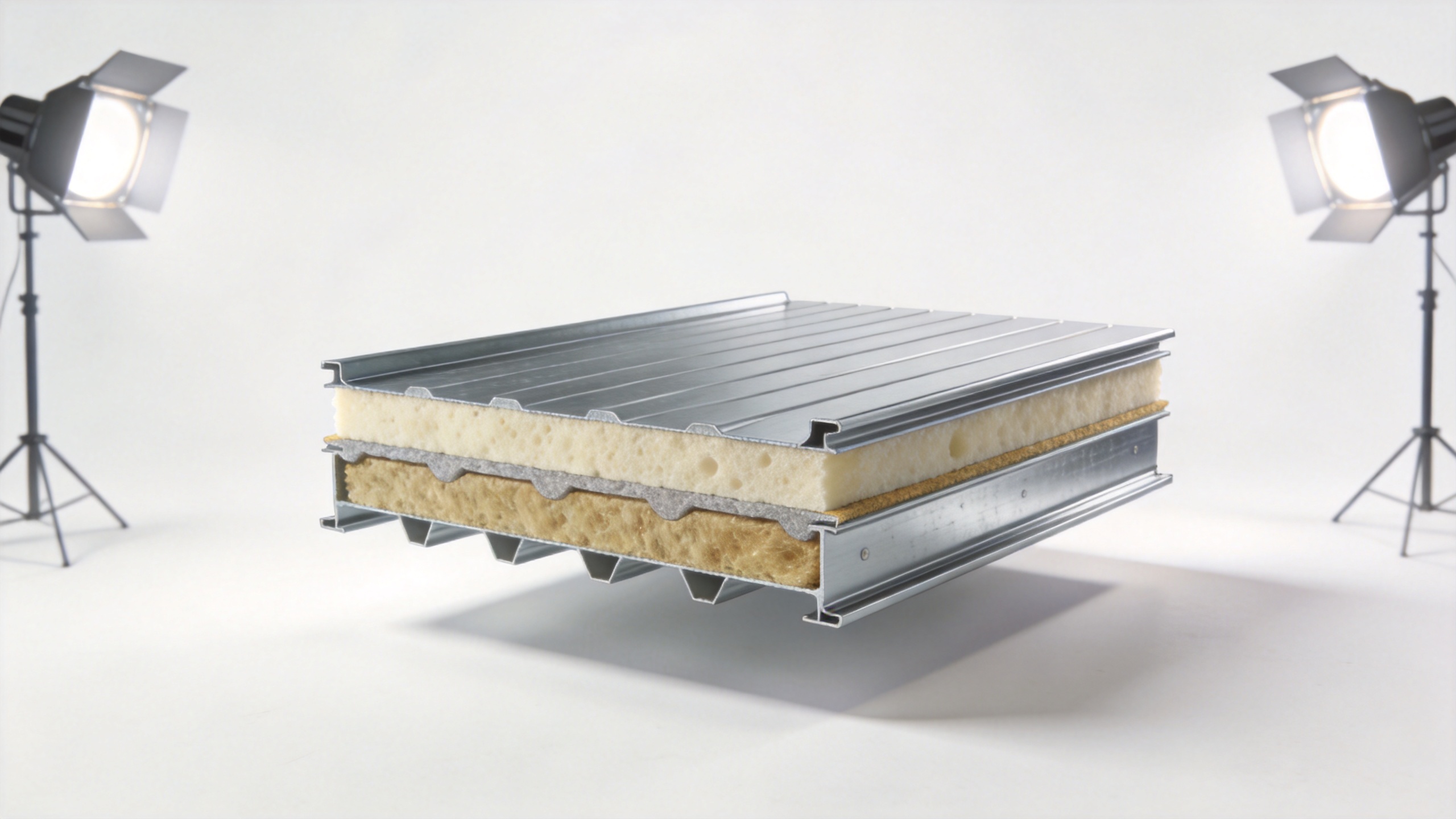
The most practically significant contrast is compressive strength. On a container house application (a modular camp building, a folding container accommodation unit, or an expandable container home) the roof panel needs to withstand both dead load and periodic maintenance access. A PUF core with higher density provides better long-term structural integrity under repeated load cycles. For wall panels, the difference is less critical unless the project involves multi-story stacking or high lateral wind loads.
Fire rating is worth clarifying separately. Both PUF and standard PU panels typically achieve B1 under DIN 4102, which classifies as "flame retardant" — not fire-resistant in the Class A sense. For EU market projects, the equivalent EN 13501-1 classification should be confirmed with the manufacturer, not assumed from the DIN designation alone. This is a compliance checkpoint that B2B buyers in regulated markets should treat as non-negotiable before issuing a purchase order.
Climate-Based Selection: Which Specification Works Where?
If your project is in a temperate European climate, both PUF and standard PU panels at 75mm thickness are typically sufficient to meet basic thermal performance requirements. The lower thermal conductivity of high-density PUF cores gives a marginal advantage, but for most Central European deployments, the energy performance difference is not the primary selection driver.
For colder climate zones such as Northern Scandinavia, Canada, or high-altitude sites, the specification calculus shifts. Panels at 100mm or above become necessary, and here the density of the PUF core plays a more important role in ensuring the foam doesn't compress or deform under thermal cycling stress. If your project or local energy code requires a minimum R-value or U-value target, verify the thermal resistance specification against that target number, not just the material type label.
In humid tropical or coastal environments — common in coastal Australia, Southeast Asia, and parts of South America — moisture resistance becomes a more active concern. Both PUF and PU use closed-cell foam that limits water ingress through the core itself. In practice, however, the quality of the steel facing and the edge sealing of the panel tends to matter more than the foam type in high-humidity deployments. A well-sealed 50mm PUF panel in a coastal project will outperform a poorly sealed 75mm PU panel when the differentiating variable is manufacturing quality rather than the insulation chemistry.
Matching Panel Specs to Project Type and Timeline
From a procurement perspective, the right panel specification depends as much on project timeline as it does on technical performance. Short-term and long-term deployments have meaningfully different cost-benefit profiles when comparing PUF vs PU options.
- Short-term construction camps (3–5 years): Standard PU panels with 50–75mm thickness provide adequate thermal and structural performance at a lower upfront cost. The lifecycle cost difference over this timeframe is minimal, and the initial budget saving can be directed elsewhere in the project.
- Semi-permanent commercial or hospitality deployments (5–15 years): High-density PUF panels at 75mm are the more appropriate specification. The compressive strength advantage and better dimensional stability reduce maintenance frequency and help preserve interior finishes over time — savings that accumulate across a longer operational cycle.
- Permanent or semi-permanent structures in regulated markets: Fire compliance documentation becomes a required procurement step, not an optional one. Confirm EN 13501-1 classification directly with the supplier for Europe-bound orders.
How ZYC Applies Insulation Standards to Container House Orders
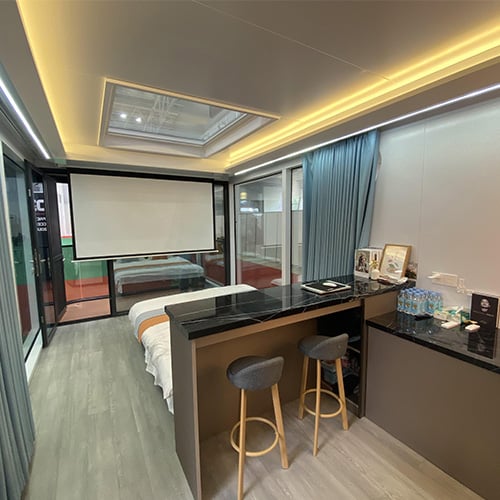
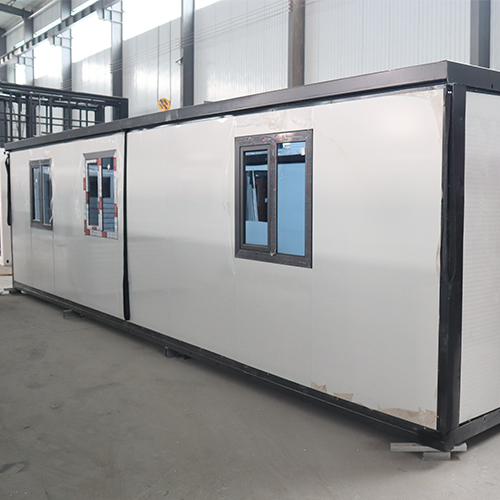
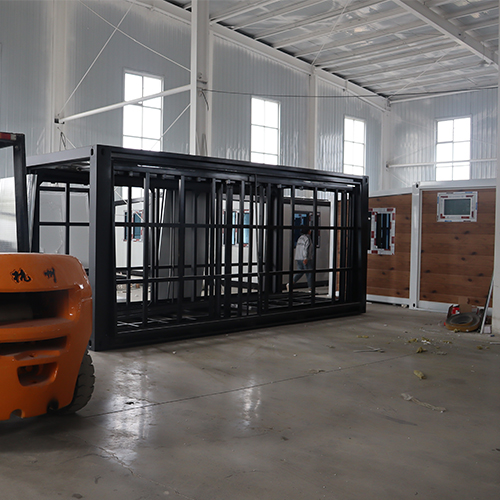
For procurement teams working with ZYC Material Technology, the container house product line — including expandable and folding models — uses sandwich panel configurations that can be aligned to project-specific requirements. ZYC builds with both standard PU and higher-density PUF core panels depending on the structural application: roof panels, exterior wall panels, and interior partition panels often carry different density and thickness specifications within the same unit.
Confirming the panel specification in writing before a production order is placed is standard practice for B2B procurement in export markets. Requesting a panel test report or specification sheet that includes foam density, thermal conductivity value, and fire classification ensures your procurement documentation is complete and defensible. ZYC's expandable container house range — available in 20ft and 40ft configurations with sandwich panel wall and roof construction — can be reviewed for specification details here: 20ft & 40ft Expandable Container House – Sandwich Panel.
Summary: PUF vs PU for Container House Procurement
For most container house procurement decisions, the PUF vs pu panel distinction resolves to a density and quality question rather than a categorical materials difference. High-density PUF panels (≥40 kg/m³) offer measurable advantages in compressive strength and long-term dimensional stability. Standard PU panels remain a cost-effective choice for shorter deployment cycles or lower-load wall applications.
The decision variables that matter most in practice are: foam core density, panel thickness relative to climate zone requirements, steel facing gauge and coating specification, and edge-sealing quality at the panel joint. If a supplier's specification sheet doesn't clarify foam density — whether they label the material PUF or PU — that's the detail worth clarifying before finalizing procurement terms.